Indicators of environmental sustainability in the automobile sector
Intensifying competition, affordable prices, and easy access to finance have triggered exponential growth in the automobile sector over the last half-century. This has brought the spotlight to the issue of environmental sustainability, to maintain the availability of resources for a long time.
The EU has instated regulations to slowly phase out internal combustion engine (ICE) vehicles by 2050 and penalise vehicle makers who exceed emission criteria. The proliferation of technology like battery, hybrid, and plug-in hybrid electric vehicles has supported this stance. Still, when it comes to commercial sales of vehicles, a fundamental shift towards EVs is yet to be witnessed.
On the manufacturing side, the adoption of the triple bottom line approach encompassing economic, social, and environmental dimensions of sustainability has been slow. Most companies still follow weak sustainability frameworks that fail to holistically implement all three pillars of sustainability and instead emphasise only the economic aspect ( Stoycheva et al., 2018). Other studies covering the broader automotive sector on sustainability frameworks of the automobile sector echo a similar sentiment. Most of the company’s focus on a single dimension of sustainability and fail to see the systemic impact of the automobile sector’s actions on the ecosystem (Yıldızbaşı et al. & Kumar & Anbananda m (2022).
Furthermore, studies on the Indian market are gravely discouraging in terms of quantity and quality, leaving a majority share of the burden on the industry to figure out an optimal sustainability framework. A sustainability framework is a system that lays out the plans and processes required to implement and execute an organisation’s strategy to achieve its sustainability goals. Most large-scale organisations especially in the manufacturing sector, are required to have a sustainability framework. However, the real challenge for these organisations is not the implementation of these frameworks but to reduction of their non-monetary risk (regulatory, operational, societal, and environmental) while maximising their long-term financial value ( Alkhasawneh, 2020).
While a sustainability framework refers to a broad guideline or approach that helps organizations integrate sustainability into their operations, an “optimal sustainability framework” enables the optimal use of resources in the production and delivery process, minimising the adverse impacts on the ecosystem (Moudi, 2022). On the other hand, sustainability reporting frameworks refer to a set of indicators and metrics that are used to measure and assess the sustainability of a system based on its natural, social, and economic aspects (Science Direct, 2017). In other words, the choice of the sustainability framework goes a long way in determining whether the concern will meet its intended sustainability targets or not. The figure below shows the scope of these three concepts- sustainability framework, optimal sustainability framework, and sustainability reporting framework.

The automobile industry’s contribution to India’s environmental degradation is well documented. By 2026, India is set to surpass Japan and Germany by volumes to become the world’s third-largest automotive, doubling the GHG burden from its current level of 338 million tons (Tillu et al., 2024). This will undoubtedly aggravate the burden on automakers to improve their sustainability performance. However, little to no innovation has taken place in the past half-decade to improve their sustainability frameworks. Virmani et al. (2021) attribute this to the lack of many crucial components, as shown in the figure below.

Identifying environmental sustainability indicators
Sustainability reporting aims to demonstrate contribution to sustainable development. A sustainability reporting framework takes into account principles of sustainable development such as equity, diversity, and interconnectedness in the social, economic, and environmental processes of a company. As discussed in the previous article, sustainability indicators are the measures that aim to interrelate and assess different areas of social, environmental, economic, institutional, and territorial development (Moreno-Pires, 2014).
Sustainability indicators are essential for two primary functions of an organisation:
- to understand the causal relationships between capital assets and intergenerational well-being, and
- to assist in policymaking and management decisions.
There are over 230 sustainability indicators identified by the United Nations Sustainable Development Goals (Shah, 2025). However, no organization can assess its impact using all of them. A key challenge in the sustainable development journey, as highlighted by Suárez-Serrano et al. (2023), is that companies tend to “cherry-pick” indicators—selecting only those that are easy to achieve or enhance their public image, rather than addressing the most critical sustainability issues. This selective approach creates a disconnect between their stated intentions and actual impact. To bridge this gap, academicians and practitioners must collaborate to identify the most relevant indicators, ensuring that companies genuinely measure and report the effectiveness of their sustainability initiatives.

When it comes to the automobile sector, there are 247 sustainability indicators (Lisowski et al., 2020). Given the constraints of time, data availability, and other resources, selecting the right sustainability indicators becomes crucial. Researchers have employed various methods in the past to identify indicators best suited to the nature of the automobile sector’s business. This article aims to review existing studies on sustainability indicators relevant to the automobile industry, as well as the methodologies used for their selection. However, due to limited research specifically focused on the automobile industry, some of the studies considered in this review pertain to the broader automotive sector.
Selection of studies for a systematic review to identify environmental sustainability indicators
A review of foundational literature performed by (Latawiec & Agol, 2015) on the selection of indicators shows that the indicators should be:
- Simple: easily communicable.
- Measurable: capable of being quantified.
- Feasible: able to be collected.
- Flexible: to allow replacement with new available data.
- Dynamic: capturing changes in stocks and flows over time.
- User-inspired: aligning with the goals of the user.
However, there are challenges associated with selecting the right sustainability indicators such as:
- definitional ambiguities of sustainability
- determining the right time scale for collecting or applying indicators
- deciding who should select the indicators
- using the ‘right’ indicators in the ‘wrong’ context
Therefore, in this study, a two-step approach was adopted to identify the relevant environmental and social sustainability indicators for the automobile sector. Firstly, we follow the method adopted previously to assess past studies on social and environmental indicator selection for automobile sector companies. However, a few indicators have been changed to suit the specific industry, i.e., automobile. Since the number of studies published on the automobile sector was less to reach a conclusive finding, the studies’ selection criteria were expanded to include the broader automotive sector.
The findings of these studies have been presented in the form of two matrices, one each for environmental indicators and social indicators. The first column of the matrix represents the author’s name and year of publication, followed by the remaining columns which represent the different environmental or social indicators. Indicators that are identified as important by the author of that study are marked in grey cells in the matrix.
A systematic review of the literature to identify the environmental sustainability indicators
The matrix below pertains to environmental sustainability. 12 studies published between 2011 and 2018 were selected for the review. Indicators were classified into 5 aspects of environmental sustainability:
- energy and water management,
- waste management,
- pollution control,
- environmental compliance,
- sustainability practices and innovation.
Each of these 5 aspects has between 5 and 13 indicators. Their common objective was to create a sustainability index using companies’ sustainability reports to identify crucial indicators which can help them optimise their sustainability performance.

GHG & air pollution emissions
The most flagged environmental indicator in the automobile sector is GHG (Scope 1, 2, and 3) emissions, followed by air pollution (SOx, NOx, and PM) emissions. Scope 1 refers to direct emissions from company-controlled sources, such as manufacturing facilities or company vehicles. Scope 2 includes indirect emissions from purchased energy like electricity used in operations. Scope 3 encompasses all other indirect emissions across the value chain, such as raw material production, vehicle transportation, and emissions from customer vehicle use. In the automobile sector, Scope 3 emissions dominate due to the lifecycle impact of vehicles, i.e., total environmental and social effects of a vehicle from production to disposal (United Nations, 2024).
Waste management practices also play a critical role in the environmental sustainability of the automobile sector. This includes waste management, hazardous/ non-hazardous waste, and solid waste produced. Energy utilisation emerged as an equally important category with total fuel consumption and total energy consumption being the most important indicators. This was followed by the sustainability practices and innovation aspect, of which packaging material’s sustainability was the most prominent.
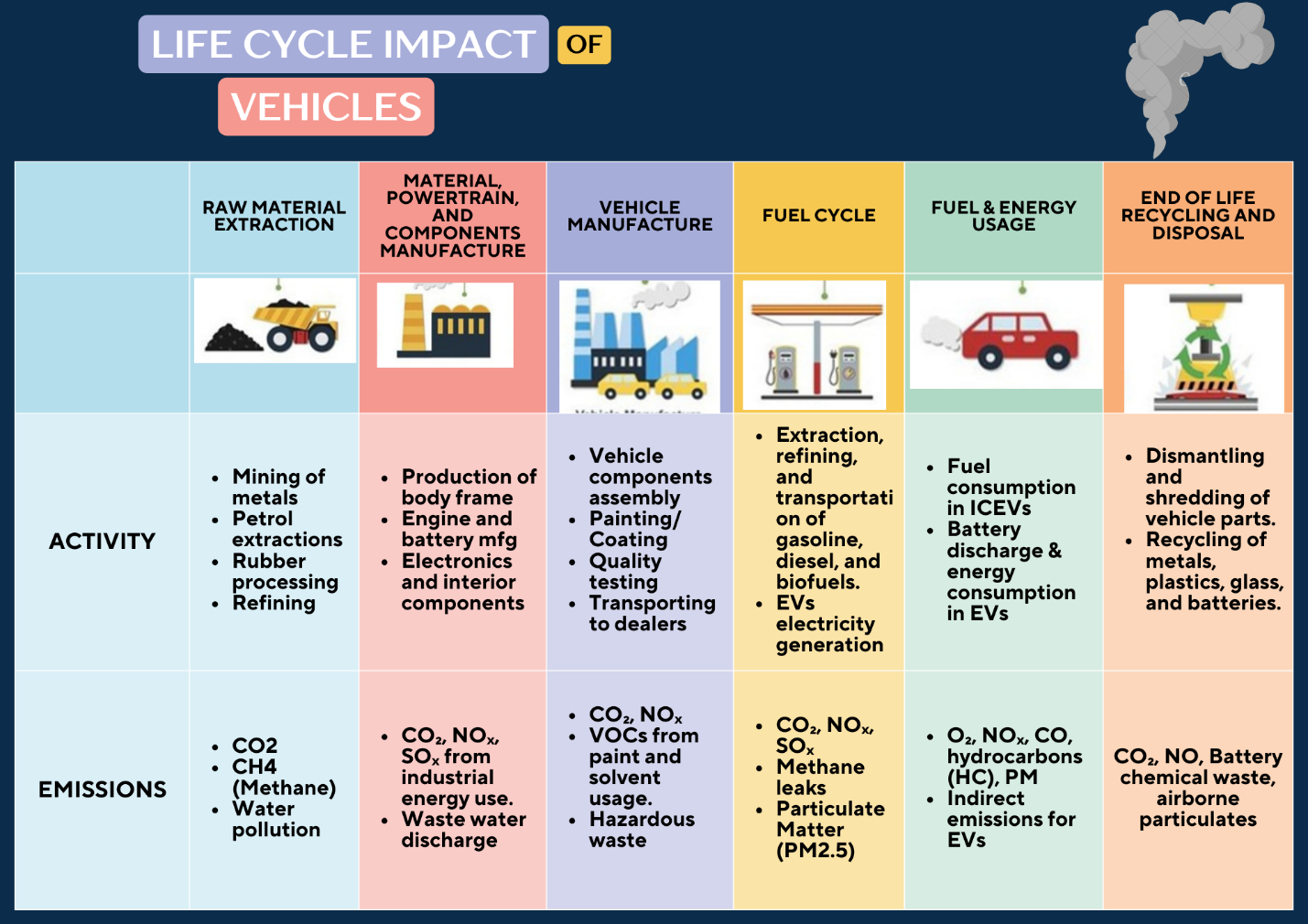
The figure above shows the different stages in the life cycle of a vehicle which has an impact on the environment. It aligns with our findings from the systematic review that PM GHG emissions and water waste are the most concerning effects throughout the different stages of a vehicle’s life cycle.
A systematic review of social indicators in the automobile industry
On the other hand, the most important social sustainability indicators for the automobile sector, as shown in the matrix below, are occupational health and safety precautions, workplace diversity, employee satisfaction, employee training and development, and stakeholder engagement and community development.

In the ‘labour practices’ aspect of social sustainability, employee training and development emerged as the most frequently cited sustainability indicator. This shows that automobile companies and researchers commonly identify continuous learning of employees as an important part of their sustainability policies. Some of the “green” training and development practices imparted to automobile sector employees include increasing employees’ environmental consciousness, instilling green values and upskilling them in execution of the green working practices. This equips them with the necessary competencies to identify environmental issues and take required actions to minimize the problem. It also helps them find their work meaningful (Chaudhary, 2019).
This was followed by health and safety which included imparting knowledge and awareness among workers in handling hazardous substances like organic solvents in the automobile industry with practices such as reading labels, wearing fully covered clothes, wearing gloves, hand hygiene, installing designated or isolated area for spray painting activity with an exhaust ventilation system installed, product labels on the material or chemical containers or bottles (Hasylin et al., 2022), availability of personal safety equipment, reliable alarm systems, provision of exits from production line, medical service, controls and inspections for safety, follow-up measures taken after injuries and accidents have taken place, and first aid training (Clarke, 2006).
In addition to reviewing past studies for critical sustainability indicators in the automobile industry, it is also important to know the methods used by these researchers to arrive at these specific indicators. It will help to identify the most suitable factor identification method for the study goals.
A review of methodologies used for sustainability indicator selection in the automobile sector
To identify relevant sustainability indicators from a vast pool of over 230, authors in the past have used different methodologies ranging from survey-based primary data analysis to more foundational approaches like literature reviews. The table below provides a review of 18 studies conducted in the past ten years.
| Authors | Method | Features |
|---|---|---|
| (A. Kumar, 2020) (Yıldızbaşı et al., 2021) | Fuzzy logic | Useful when dealing with vague or uncertain information. Is rule-based and expert-driven. |
| (Salvado et al., 2015) (D. Kumar & Garg, 2017) (Shao et al., 2016) | Analytic Hierarchy Process (AHP). | Relies on expert judgment to assign weights to different indicators. Requires pairwise comparisons for every indicator, which becomes impractical for large datasets |
| (Stoycheva et al., 2018) | MCDA + sensitivity analysis | Assign weights based on stakeholder preferences, which can vary and introduce subjectivity. Requires multiple scenarios to check for stability. |
| (Olugu et al., 2011) (Gopal & Thakkar, 2016) | Survey data | Captures human perception, which can be subjective and limited by response biases. Requires additional analysis to interpret results effectively. |
| (Zanchi et al., 2018) (Sukitsch et al., 2015) (Lisowski et al., 2020) (Schöggl et al., 2016) (Drohomeretski et al., 2015) (Comoglio & Botta, 2012) (Amrina & Yusof, 2011) | No statistical analysis | Review-based. Lacks validation based on real-world industry data. Subjective and based on researchers’ perception |
| (Rao, 2021) | Principal Component Analysis (PCA) | Identifies key factors purely from the dataset without requiring predefined rules. Significant indicators emerge from the data rather than human perception. Liminates subjectivity by using eigenvalues and eigenvectors. Sextracts key patterns from the data itself. |
Most of these studies do not use any statistical approach, instead rely on literature reviews or expert judgment. Such an approach has a good theoretical grounding, but can often miss trending or upcoming indicators. The only way to detect emerging indicators is by observing the latest empirical data obtained straight from the source. The most recent empirical data on automobile companies’ sustainability efforts are present in the form of official sustainability reports and annual reports. Companies report their sustainability achievement in the form of metrics such as GHG (Scope 1, Scope 2, Scope 3) emissions during their previous year, the number of employees given training for health and safety, wastewater generated/ recycled/ reused, etc., i.e.
The sustainability indicators actively reported by the companies were first identified, which helped to understand what companies prioritise but failed to indicate which indicators matter the most, or whether some are more influential than others. To solve this, Principal Component Analysis (PCA) was applied. Instead of relying on personal judgment or subjective rankings, PCA lets the data speak for itself, ensuring that the focus is only on the most meaningful sustainability factors. This approach made the findings more objective, clear, and useful for industry decision-making.
References
- Alkhasawneh, R. (2020). A Proposed Framework for Integrating Sustainability Into Corporate Business Practices. International Journal of Innovation, Creativity and Change, 14(12). https://www.researchgate.net/publication/349807835_A_Proposed_Framework_for_Integrating_Sustainability_Into_Corporate_Business_Practices
- Amrina, E., & Yusof, S. M. (2011). Key performance indicators for sustainable manufacturing evaluation in automotive companies. 2011 IEEE International Conference on Industrial Engineering and Engineering Management, 1093–1097. https://doi.org/10.1109/IEEM.2011.6118084
- Arcelor Mittal. (2023). Life cycle assessment. Arcelor Mittal. https://automotive.arcelormittal.com/sustainability/life_cycle_assessment
- Bhanot, N., Rao, P. V., & Deshmukh, S. G. (2016). An Assessment of Sustainability for Turning Process in an Automobile Firm. Procedia CIRP, 48, 538–543. https://doi.org/10.1016/j.procir.2016.03.024
- Chaudhary, R. (2019). Green human resource management in Indian automobile industry. Journal of Global Responsibility, 10(2), 161–175. https://doi.org/10.1108/JGR-12-2018-0084
- Clarke, S. (2006). Safety climate in an automobile manufacturing plant: The effects of work environment, job communication and safety attitudes on accidents and unsafe behaviour. Personnel Review, 35(4), 413–430. https://doi.org/10.1108/00483480610670580
- Comoglio, C., & Botta, S. (2012). The use of indicators and the role of environmental management systems for environmental performances improvement: A survey on ISO 14001 certified companies in the automotive sector. Journal of Cleaner Production, 20(1), 92–102. https://doi.org/10.1016/j.jclepro.2011.08.022
- Drohomeretski, E., Da Costa, S. E. G., De Lima, E. P., & De Oliveira Neves, T. R. (2015). The Application of Sustainable Practices and Performance Measures in the Automotive Industry: A Systematic Literature Review. Engineering Management Journal, 27(1), 32–44. https://doi.org/10.1080/10429247.2015.11432034
- Gopal, P. R. C., & Thakkar, J. (2016). Sustainable supply chain practices: An empirical investigation on Indian automobile industry. Production Planning & Control, 27(1), 49–64. https://doi.org/10.1080/09537287.2015.1060368
- Hasylin, H., Abdul-Mumin, K. H., Pg-Hj-Ismail, P.-K., Trivedi, A., & Win, K. N. (2022). A Preliminary Assessment of Health and Safety in the Automobile Industry in Brunei Darussalam: Workers’ Knowledge and Practice of Organic Solvents. International Journal of Environmental Research and Public Health, 19(23), Article 23. https://doi.org/10.3390/ijerph192315469
- Jasiński, D., Meredith, J., & Kirwan, K. (2016). A comprehensive framework for automotive sustainability assessment. Journal of Cleaner Production, 135, 1034–1044. https://doi.org/10.1016/j.jclepro.2016.07.027
- Kumar, A., & A, R. (2020). An MCDM framework for assessment of social sustainability indicators of the freight transport industry under uncertainty. A multi-company perspective. Journal of Enterprise Information Management, 33(5), 1023–1058. https://doi.org/10.1108/JEIM-09-2019-0272
- Kumar, A., & Anbanandam, R. (2022). Assessment of environmental and social sustainability performance of the freight transportation industry: An index-based approach. Transport Policy, 124, 43–60. https://doi.org/10.1016/j.tranpol.2020.01.006
- Kumar, D., & Garg, C. P. (2017). Evaluating sustainable supply chain indicators using fuzzy AHP: Case of Indian automotive industry. Benchmarking: An International Journal, 24(6), 1742–1766. https://doi.org/10.1108/BIJ-11-2015-0111
- Latawiec, A., & Agol, D. (2015). Sustainability Indicators in Practice. De Gruyter Open Ltd.
- Lisowski, S., Berger, M., Caspers, J., Mayr-Rauch, K., Bäuml, G., & Finkbeiner, M. (2020). Criteria-Based Approach to Select Relevant Environmental SDG Indicators for the Automobile Industry. Sustainability, 12(21), Article 21. https://doi.org/10.3390/su12218811
- Moreno-Pires, S. (2014). Indicators of Sustainability. In A. C. Michalos (Ed.), Encyclopedia of Quality of Life and Well-Being Research (pp. 3209–3214). Springer Netherlands. https://doi.org/10.1007/978-94-007-0753-5_3380
- Moudi, M. (2022). Adaptive Optimal Sustainability Framework In Urban Water Supply System Under Different Runoff Scenarios. https://doi.org/10.21203/rs.3.rs-980003/v2
- Olugu, E. U., Wong, K. Y., & Shaharoun, A. M. (2011). Development of key performance measures for the automobile green supply chain. Resources, Conservation and Recycling, 55(6), 567–579. https://doi.org/10.1016/j.resconrec.2010.06.003
- Rao, S.-H. (2021). A hybrid MCDM model based on DEMATEL and ANP for improving the measurement of corporate sustainability indicators: A study of Taiwan High Speed Rail. Research in Transportation Business & Management, 41, 100657. https://doi.org/10.1016/j.rtbm.2021.100657
- Salvado, M. F., Azevedo, S. G., Matias, J. C. O., & Ferreira, L. M. (2015). Proposal of a Sustainability Index for the Automotive Industry. Sustainability, 7(2), Article 2. https://doi.org/10.3390/su7022113
- Schöggl, J.-P., Fritz, M. M. C., & Baumgartner, R. J. (2016). Sustainability Assessment in Automotive and Electronics Supply Chains—A Set of Indicators Defined in a Multi-Stakeholder Approach. Sustainability, 8(11), Article 11. https://doi.org/10.3390/su8111185
- Science Direct. (2017). Sustainability Framework—An overview | ScienceDirect Topics. https://www.sciencedirect.com/topics/earth-and-planetary-sciences/sustainability-framework
- Shah, K. (2025). Sustainable Development Index Using MILP to Assign Relative Weight To Different UNSDG Parameters. In P. Festa, D. Ferone, T. Pastore, & O. Pisacane (Eds.), Learning and Intelligent Optimization (pp. 377–398). Springer Nature Switzerland. https://doi.org/10.1007/978-3-031-75623-8_30
- Shao, J., Taisch, M., & Ortega Mier, M. (2016). A study on a configuration model for facilitating sustainable consumption: A case involving the automobile industry in Italy. Journal of Cleaner Production, 137, 507–515. https://doi.org/10.1016/j.jclepro.2016.07.130
- Singh, R. K., Murty, H. R., Gupta, S. K., & Dikshit, A. K. (2012). An overview of sustainability assessment methodologies. Ecological Indicators, 15(1), 281–299. https://doi.org/10.1016/j.ecolind.2011.01.007
- Stoycheva, S., Marchese, D., Paul, C., Padoan, S., Juhmani, A., & Linkov, I. (2018). Multi-criteria decision analysis framework for sustainable manufacturing in automotive industry. Journal of Cleaner Production, 187, 257–272. https://doi.org/10.1016/j.jclepro.2018.03.133
- Suárez-Serrano, E., González-Torre, P. L., & Covián-Regales, E. (2023). A business prioritisation of the sustainable development goals indicators: Building bridges between academics and practitioners in the Spanish case. Environmental Development, 46, 100827. https://doi.org/10.1016/j.envdev.2023.100827
- Sukitsch, M., Engert, S., & Baumgartner, R. (2015). The Implementation of Corporate Sustainability in the European Automotive Industry: An Analysis of Sustainability Reports. Sustainability, 7(9). https://www.researchgate.net/publication/281303891_The_Implementation_of_Corporate_Sustainability_in_the_European_Automotive_Industry_An_Analysis_of_Sustainability_Reports
- Tillu, P. G., Digalwar, A. K., Singh, S. R., & Reosekar, R. S. (2024). Towards sustainable automobile ecosystem in India: Integrated analysis of technical, economic, and ESG dimensions. Cleaner Environmental Systems, 14, 100210. https://doi.org/10.1016/j.cesys.2024.100210
- United Nations. (2024). Climate Target Setting for Automotive Sector Financing. United Nations. https://www.unepfi.org/wordpress/wp-content/uploads/2024/04/Climate-Target-Setting-for-Automotive-Sector-Financing_Emerging-Practice_NZBA.pdf
- Virmani, N., Bera, S., & Kumar, R. (2021). Identification and testing of barriers to sustainable manufacturing in the automobile industry: A focus on Indian MSMEs. Benchmarking: An International Journal, 28(3), 857–880. https://doi.org/10.1108/BIJ-08-2020-0413
- Yıldızbaşı, A., Öztürk, C., Efendioğlu, D., & Bulkan, S. (2021). Assessing the social sustainable supply chain indicators using an integrated fuzzy multi-criteria decision-making methods: A case study of Turkey. Environment, Development and Sustainability, 23(3), 4285–4320. https://doi.org/10.1007/s10668-020-00774-2
- Zanchi, L., Delogu, M., Zamagni, A., & Pierini, M. (2018). Analysis of the main elements affecting social LCA applications: Challenges for the automotive sector. The International Journal of Life Cycle Assessment, 23(3), 519–535. https://doi.org/10.1007/s11367-016-1176-8
I am a management graduate with specialisation in Marketing and Finance. I have over 12 years' experience in research and analysis. This includes fundamental and applied research in the domains of management and social sciences. I am well versed with academic research principles. Over the years i have developed a mastery in different types of data analysis on different applications like SPSS, Amos, and NVIVO. My expertise lies in inferring the findings and creating actionable strategies based on them.
Over the past decade I have also built a profile as a researcher on Project Guru's Knowledge Tank division. I have penned over 200 articles that have earned me 400+ citations so far. My Google Scholar profile can be accessed here.
I now consult university faculty through Faculty Development Programs (FDPs) on the latest developments in the field of research. I also guide individual researchers on how they can commercialise their inventions or research findings. Other developments im actively involved in at Project Guru include strengthening the "Publish" division as a bridge between industry and academia by bringing together experienced research persons, learners, and practitioners to collaboratively work on a common goal.
Discuss