A Quantitative Approach to Business Process Analysis
In decision-centred organisations, the essence of value creation lies in the quality of the decisions made and the outcomes they produce, rather than merely the volume of activities undertaken. Decisions function as distinct and identifiable choice points that are embedded within business processes. These critical junctures mark where the direction of a business process can change, influencing the results achieved. The outcomes, in turn, are the observable changes in state or the results that stem directly from these enacted decisions. This perspective places emphasis on the decision-making process as the primary driver of organisational effectiveness and efficiency, highlighting its role in determining the overall performance of the business.
A distinctive modeling approach within this context involves mapping business process, that includes fundamental business transactions defined in enterprise ontology. By identifying and representing these core transactions, businesses can gain clearer insights into how decisions are made and how these decisions translate into observable outcomes. This ontological mapping provides a structured framework for understanding the flow of decisions and their impact, allowing for more precise analysis and improvement of business processes.
Christensen & Knudsen (2013) argue, how decisions are organized fundamentally shapes organizational performance. Organizations have traditionally been understood through the lens of their activities, processes, workflows, and operations that constitute their daily functions. However, a growing body of research suggests that this activity-centric view obscures a more fundamental source of organizational value: the quality of decisions and the outcomes they generate. Yet, the systematic coordination and cultivation of organizational decision processes have received far less attention than operational business processes (Bock, 2015). The shift toward decision-centered organizational thinking therefore requires a clear conceptual separation of activities and decisions.
Business Process as a Collective Work System
Understanding business activities requires theoretical frameworks that can capture the complex interplay between human actors, technological tools, organizational rules, and social structures. Activity Theory, originating from the cultural-historical psychology tradition of Vygotsky, Leontiev, and Engeström, has emerged as a powerful lens for analyzing work practices in organizational contexts (Ajgaonkar et al., 2022; Goncalves et al., 2013; Marken, 2008). Activity Theory posits that human actions have their roots in collective life experiences, with higher mental functions shaped by social and cultural origins (Vygotskij & Cole, 1981). In this perspective, individual behaviour is embedded within collectively organised activities that are mediated by artefacts such as mechanical tools and softwares (Vakkayil, 2010). When applying this framework, a business model is best understood as an activity system that has an integrated set of tasks carried out by various enactors. Research on dynamic capabilities further describes activities like good work organization and proper planning, working in virtual teams, maintaining efficient IT systems, and moving resources quickly as central tasks to how businesses respond to crises (Dyduch et al., 2021).
Business activities are characterised by the utilisation of human, physical, or capital resources to accomplish specific objectives that support broader organisational goals. Crucially, these activities are not restricted to the internal boundaries of a single company. Instead, they function as interconnected systems, with interdependencies arising from individuals who design both the activities and the transactional links that bind them into a cohesive whole. This activity system naturally expands to include a range of stakeholders like entrepreneurs, human capital, partners, suppliers, and customers. The purpose of such a system is to generate value for all involved parties, while simultaneously enabling the focal firm to capture its share of that value (Zott & Amit, 2010).
In a manufacturing unit the activity is the ongoing process of production planning and execution, involving managers, production supervisors, machine operators, quality inspectors, and logistics coordinators.
The way business activities relate to and influence one another becomes a key factor in determining how the organisation’s collective work system adapts or performs over time. Consequently, tasks and interactions are analysed using process maps to reveal who performs what tasks, how tools mediate their work, and what interaction patterns characterize business activities (Ajgaonkar et al., 2022; Bardram & Doryab, 2011; Goncalves et al., 2013). This technique is valuable for work design, training program development, and business process improvement. Process maps, originating in the Unified Modeling Language (UML), are widely used to represent workflows, task sequencing, and responsibility allocation within organizational systems. When process maps are interpreted through socio-technical lenses, they become diagnostic instruments for understanding contextual influences (Nikolai & Bazley, 1977). In highly digitalized environments, diagrams highlight formalized control, traceability, and structured interaction. In labor-dominant environments, they reveal adaptive coordination, human-centered decision points, and relational dynamics. When analyzed critically, process maps become more than workflow charts; they are maps of how organizations structure choice, manage interdependence, and translate resources into coordinated action under constraints.
Modeling business processes using Unified Modeling Language (UML)
Business processes encompass the specific actions that companies undertake to produce or deliver their products and services. In many service and operational environments, business processes are described in narrative terms, such as “take order”, “prepare food” or “deliver”. The way business processes are designed and performed affects how involved stakeholders perceive efficiency. The design and implementation of these processes directly influence the stakeholder experience and determine the overall performance of the business. While these descriptions offer a general understanding of activities, they lack the precision needed for quantitative research and rigorous performance assessment. Therefore, it is essential to decompose business into measurable metrics that capture the specifics of each step. To facilitate this, UML-based process maps are employed as a standardised visual language for representing business actions. These diagrams detail the control flows, decision nodes, parallel branches, and synchronisation points that define how activities are executed and coordinated. It is a consistent modeling language that can be understood across teams, companies, and industries. UML provided standardized symbols and diagram types, reducing ambiguity. Furthermore, Dumas et al. (2018) also emphasized that process modeling establishes a common language for business stakeholders, which is foundational before any improvement initiative can begin.
In linear service operation businesses, processes manifest as informal routines rather than being formally documented or standardised. Considering the order placement process at a college canteen counter. Here, the sequence of actions typically consists of:

Each step in this process is carried out based on established habits or customary practices rather than any written procedures. Such informal routines, while functional, introduces variability and inefficiencies, as they rely heavily on the tacit knowledge and experience of individual staff members. Consequently, a business process map clarifies where time accumulates, where decisions introduce variability such as custom orders and where parallelization is possible.
Imagine a crowded college canteen. Students are waiting, the cashier is handling payments, the kitchen is juggling orders, and someone just complained that their sandwich had extra mayo when they asked for less. Everyone says, “The system is messy”. As an analyst take the real-world chaos of the canteen and convert it into a structured UML Activity Diagram using PlantUML.
Hint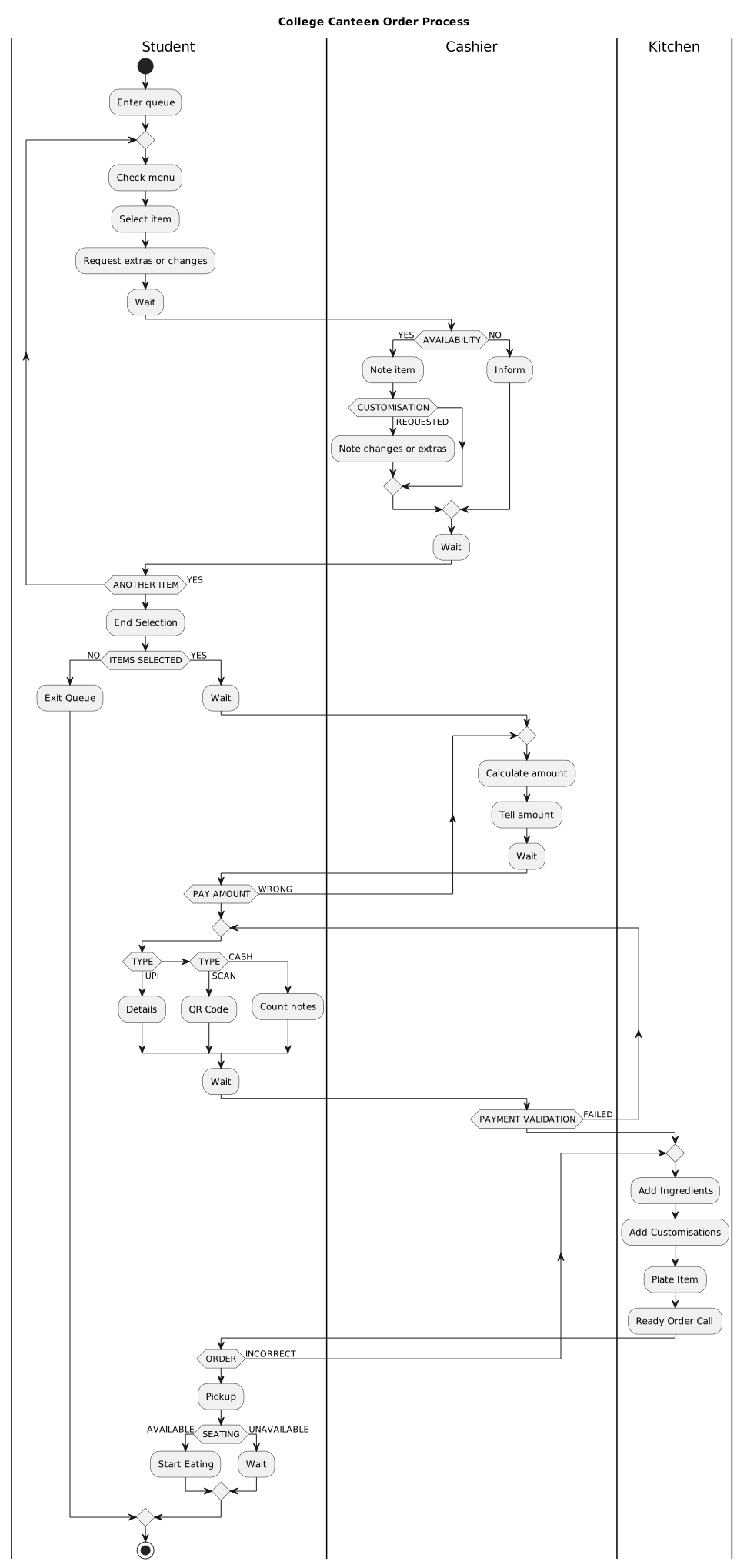
Empirical research in business process management emphasizes that performance analysis depends on clear process models. Dumas et al. (2018) argues that process modeling is the prerequisite for systematic performance measurement because metrics must attach to well-defined process elements. In service systems like a college canteen, the process may appear straightforward. But, once mapped, organizational logic becomes a structured decision system rather than an informal routine. This enables causal attribution that further explains whether delays originate at order capture, food preparation, or billing. The canteen process map is valuable not because it looks complete, but because it turned a messy service reality into a measurement-ready unit of analysis. Moreover, Gotel & Finkelstein (1994) discuss traceability as essential for maintaining alignment between actions and objectives.
If total service time increases, it can be traced back to a specific activity node such as queue, payment processing or preparation.
The key methodological point is that the map helps to define KPIs per activity, not just an overall “waiting time”. Consequently, even if no optimization is pursued, the map also helps with traceability that supports internal audits and regulatory requirements. Furthermore, research on model understandability emphasizes that models play a pivotal organizational role. Multiple stakeholders must interpret them consistently therefore understandability becomes a core quality attribute of process models (Corradini et al., 2018). Moreover, modern empirical BPM increasingly relies on event data to quantify performance and deviations. Work by Song & van der Aalst (2007) also shows how event logs can yield performance metrics both for the overall process and for individual activities.
Translating Activity Maps into a Quantitative Data Analysis
Before any analysis, simulation, forecasting, or throughput modeling can be meaningfully applied, the data structure must be rigorously defined. Without a precise data structure, analytical methods produce numerical outputs, but those outputs lack interpretive reliability. To measure at activity level, it is required to move from a diagram to an event log where each row is one event occurrence. Process-mining literature highlights that the quality of insights depends heavily on event-log preparation and the consistency of activity labels and attributes (Marin-Castro & Tello-Leal, 2021). The canteen order process diagram shows sequence, branching, and responsibility. For probabilistic decision making or forecasting, each of those elements must be converted into measurable variables and stochastic parameters.
The student’s waiting time in the college canteen consists of several steps: Queue time, Order selection, Payment, Preparation, and Delivery.
- Queue Time: Measured from entering the queue to starting the order with the cashier.
- Order Selection Time: The period for choosing and stating the order.
- Payment Time: Time from calculating the order total to payment completion.
- Preparation Time: Begins when kitchen staff start preparing the order and ends when it’s ready.
- Delivery Time: From the order being called ready to the student picking it up.
Queueing models depend on accurate estimates of arrival rate and service rate. Arrival rate requires consistent capture of interarrival timestamps. Service rate requires precise start and end times per activity or per service stage. If timestamps are coarse, missing, or inconsistently recorded, utilization calculations become unreliable, and forecasted waiting times can deviate significantly from reality. Tracking timestamps for each stage enables calculation of total waiting time and helps identify where to improve service steps. This is consistent with process mining and event-log-based analytics approaches used in BPM research (Song & van der Aalst, 2007). Once distributions are estimated, decisions can be evaluated in terms of expectations.
Reducing queue time by introducing pre-order system, minimising customisations during peak hours and reducing rework and meal prep time by improving the process transition from cashier to kitchen process.
Analysis techniques predominantly also employ contradiction analysis to identify structural tensions that drive organizational change, complemented by task and interaction analysis. Contradiction analysis is the most prevalent analytical technique in activity-based business research. It is employed to identify structural tensions that drive organizational change and create opportunities for intervention (Goncalves et al., 2013; Suratmethakul & Hasan, 2004; Weeger & Haase, 2016). Contradiction analysis can help transform vague tensions such as “faster delivery and more variety” into measurable trade-offs that can be modeled statistically and simulated. The data must distinguish standard orders from customized ones and track their separate service-time distributions. If the dataset aggregates both types into a single service-time variable, the variance component that drives queue instability remains hidden. Analytical methods cannot compensate for structural blindness in data design.
These techniques help to diagnose organizational problems, understand resistance to change, and identify opportunities for intervention. Emerging computational approaches to organizational analysis such as process mining, social network analysis and natural language processing could be integrated with activity level analysis. In rigorous business analytics, the process model defines what should be measured, and the data structure ensures that it is measured consistently. The UML map provides the ontology of activities; the data schema operationalizes that ontology into variables. Only when this mapping is exact can simulation, regression, probabilistic modeling, or forecasting produce defensible insights.
References
- Ajgaonkar, S., Neelam, N., Behl, A., Dao, L. T., & Lang, L. D. (2022). Exploring human resource work design, learning mechanism and TQM: Through the lens of activity theory and contextual learning theory. The TQM Journal , 34 (1), 70–101. https://doi.org/10.1108/TQM-03-2021-0085
- Bardram, J., & Doryab, A. (2011). Activity analysis: Applying activity theory to analyze complex work in hospitals. Proceedings of the ACM 2011 Conference on Computer Supported Cooperative Work , 455–464. https://doi.org/10.1145/1958824.1958895
- Bock, A. (2015). Beyond Narrow Decision Models: Toward Integrative Models of Organizational Decision Processes. 2015 IEEE 17th Conference on Business Informatics , 181–190. https://doi.org/10.1109/CBI.2015.34
- Corradini, F., Ferrari, A., Fornari, F., Gnesi, S., Polini, A., Re, B., & Spagnolo, G. O. (2018). A Guidelines framework for understandable BPMN models. Data & Knowledge Engineering , 113 , 129–154. https://doi.org/10.1016/j.datak.2017.11.003
- Dumas, M., La Rosa, M., Mendling, J., & Reijers, H. A. (2018). Fundamentals of Business Process Management . Springer Berlin Heidelberg. https://doi.org/10.1007/978-3-662-56509-4
- Goncalves, A., Zacarias, M., & Sousa, P. (2013). Mapping ontological transaction into Activity. In Iberian Conference on Information Systems and Technologies, CISTI (p. 7).
- Gotel, O. C. Z., & Finkelstein, C. W. (1994). An analysis of the requirements traceability problem. Proceedings of IEEE International Conference on Requirements Engineering , 94–101. https://doi.org/10.1109/ICRE.1994.292398
- Marin-Castro, H. M., & Tello-Leal, E. (2021). Event Log Preprocessing for Process Mining: A Review. Applied Sciences , 11 (22), 10556. https://doi.org/10.3390/app112210556
- Marken, J. A. (2008). An Application of Activity Theory. Performance Improvement Quarterly , 19 (2), 27–49. https://doi.org/10.1111/j.1937-8327.2006.tb00364.x
- Nikolai, L. A., & Bazley, J. D. (1977). An Analysis of the Organizational Interaction of Accounting Departments. Academy of Management Journal , 20 (4), 608–621. https://doi.org/10.2307/255360
- Song, M., & van der Aalst, W. M. (2007). Supporting process mining by showing events at a glance. Proceedings of the 17th Annual Workshop on Information Technologies and Systems (WITS) , 139–145.
- Suratmethakul, W., & Hasan, H. (2004). An activity theory analysis of a case of IT-driven organisational change . https://ro.uow.edu.au/articles/conference_contribution/An_activity_theory_analysis_of_a_case_of_IT-driven_organisational_change/27691344
- Vakkayil, J. D. (2010). Activity Theory: A Useful Framework for Analysing Project-Based Organizations. Vikalpa: The Journal for Decision Makers , 35 (3), 1–18. https://doi.org/10.1177/0256090920100301
- Vygotskij, L. S., & Cole, M. (1981). Mind in society: The development of higher psychological processes (Nachdr.). Harvard Univ. Press.
- Weeger, A., & Haase, U. (2016, January). How Contradictions Facilitate Evolutionary Transformation: An Exploration into the Dynamics of Business-IT Alignment from the Perspective of Activity Theory .
I am an interdisciplinary educator, researcher, and technologist with over a decade of experience in applied coding, educational design, and research mentorship in fields spanning management, marketing, behavioral science, machine learning, and natural language processing. I specialize in simplifying complex topics such as sentiment analysis, adaptive assessments and data visualizatiion. My training approach emphasizes real-world application, clear interpretation of results and the integration of data mining, processing, and modeling techniques to drive informed strategies across academic and industry domains.
Discuss