Understanding what research is
Research in common parlance refers to a search for knowledge. One can also define research as a scientific and systematic search for pertinent information on a specific topic. In fact, it is an art of scientific investigation.
Advanced Learner’s Dictionary of Current English, is defined as “a careful investigation or inquiry, especially through search for new facts in any branch of knowledge”. Therefore, in simple terms, it is a study undertaken by the researcher to gain new knowledge in their field of interest.
Different types of research
A study to gain knowledge and seek answers to questions with the application of scientific procedures and methods has specific objectives which can be categorized into 4 main categories:
- Exploratory: To gain familiarity with the research phenomenon or to achieve new insights.
- Descriptive: To determine the characteristics of a situation, or group of individuals, concerning a research phenomenon.
- Diagnostic: To determine the frequency with which something occurs individually or when it is associated with something else.
- Hypothesis testing: To determine the causal relationship between variables (independent and dependent variables) within the study.
General steps to follow while conducting research
- Formulate problems.
- Conduct a literature review.
- Identify key concepts and define them.
- Formulate research questions, objectives and hypothesis (if it is appropriate).
- Identify the methodology which will be adopted to carry out the study.
- Collect data.
- Analyse and discuss data.
- Draw appropriate conclusions.
- Write the research report.
In this article, we will focus on steps 5 and 6. Various methods used in research methodology and data collection will be discussed in detail. A general outline of the research methods and tools has been outlined below in a flow chart.
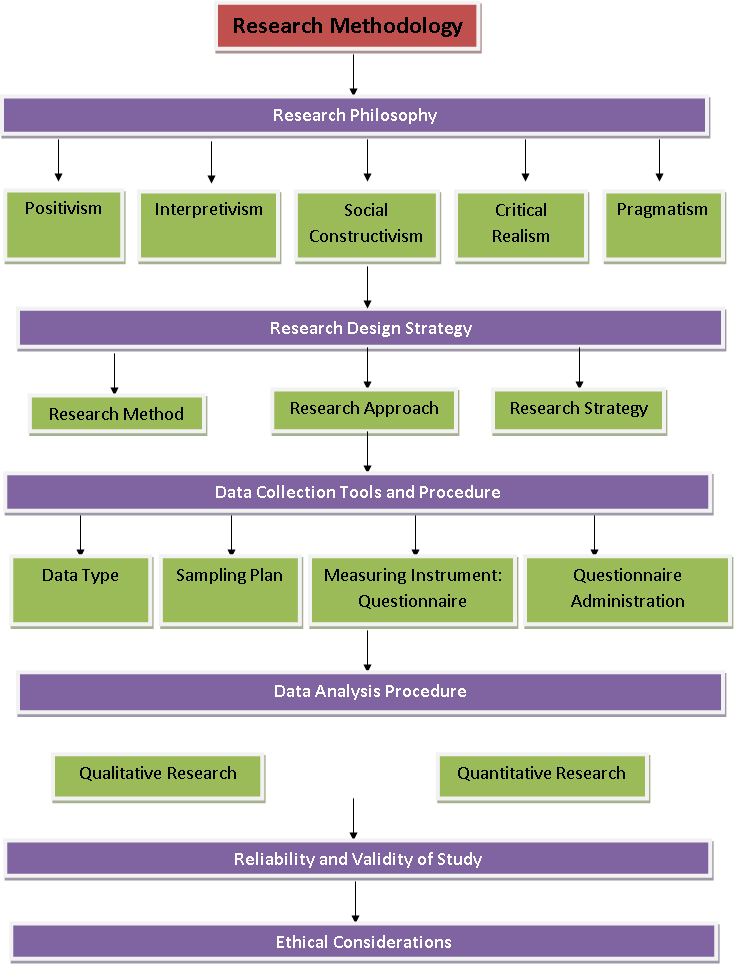
Each of these methods and procedures will be discussed in detail within this module. However, here I would also be discussing things to keep in mind while writing the methodology chapter.
- Rather than presenting definitions and explanations of the methods, emphasize more on justification as to why you choose a particular method with respect to the particular research study.
- Conclude previous studies while developing the measuring instrument i.e. questionnaire, so that you have an explanation about why a particular question is included in the research questionnaire.
- During the Literature review, identify factors which you will be testing in the primary analysis. These factors should be presented in the conceptual framework within Research methodology chapter.
Reference:
- The Advanced Learner’s Dictionary of Current English, Oxford, 1952, p. 1069
I am a management graduate with specialisation in Marketing and Finance. I have over 12 years' experience in research and analysis. This includes fundamental and applied research in the domains of management and social sciences. I am well versed with academic research principles. Over the years i have developed a mastery in different types of data analysis on different applications like SPSS, Amos, and NVIVO. My expertise lies in inferring the findings and creating actionable strategies based on them.
Over the past decade I have also built a profile as a researcher on Project Guru's Knowledge Tank division. I have penned over 200 articles that have earned me 400+ citations so far. My Google Scholar profile can be accessed here.
I now consult university faculty through Faculty Development Programs (FDPs) on the latest developments in the field of research. I also guide individual researchers on how they can commercialise their inventions or research findings. Other developments im actively involved in at Project Guru include strengthening the "Publish" division as a bridge between industry and academia by bringing together experienced research persons, learners, and practitioners to collaboratively work on a common goal.
Discuss